European Coin Collecting Basics
Coins represent stamped historical authority. European coinage spans 2,600 years from archaic Greek colonies in Magna Graecia to modern euro decimalization. Success requires systematic taxonomy rather than impulse acquisitions.
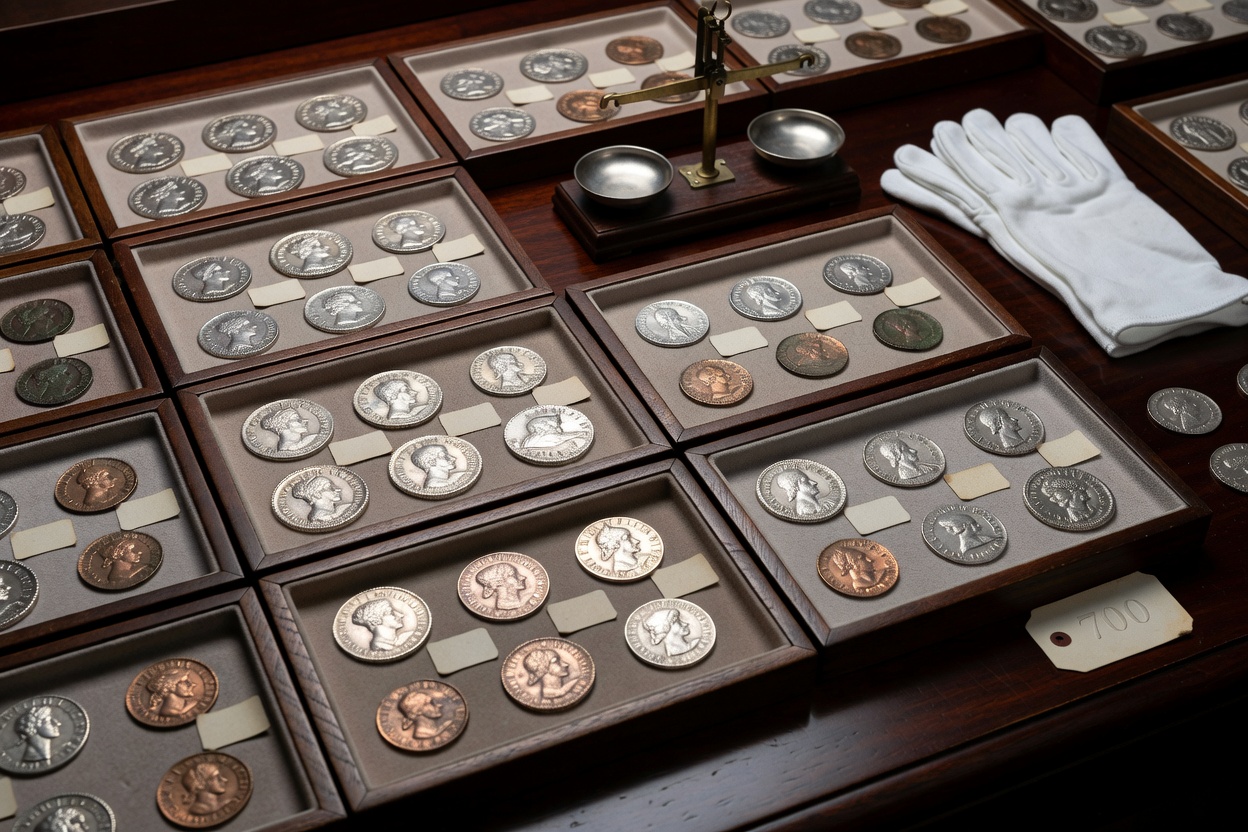
1. Denominations and Chronological Epochs
European coin production divides into five distinct metallurgical eras. Ancient Greek and Roman issues rely on staters, drachms, denarii, and sesterces. Medieval Europe operated largely on the silver penny standard established by Charlemagne in 781 AD. Early Modern Europe shifted to large silver crowns, known as thalers, ecus, and daalders.
The nineteenth century introduced gold standard alignments under the Latin Monetary Union in 1865. The modern era began with post-1945 base metal alloys and unified under the Eurozone in 2002.
2. Key Technical Terminology
Obverse & Reverse
Obverse: The primary side, usually displaying the portrait, monarch, or national symbol. Reverse: The secondary side displaying denomination, date, or allegorical figures.
Planchet (Flan)
The uncoined blank metal disc prepared for striking. Irregular edges and weight variations reflect manual flan casting in ancient and medieval mints.
Field & Relief
Field: The flat background surface of the coin. Relief: The raised device or design struck above the flat plane.
Patination
A natural chemical oxidation layer developed on copper, bronze, and silver over decades or centuries. Never clean or strip this protective skin.
3. Condition Grading Standards
Grading measures wear from circulation. It does not measure rarity or monetary value. European catalogers traditionally utilize qualitative terminology, while international institutions often correlate these with the Sheldon 70-point scale:
- FDC (Fleur de Coin / MS-65 to 70): No trace of wear. Full mint luster present. Perfect strike details.
- Extremely Fine (Vorzüglich / EF / XF 40-45): Minimal wear on the highest design points. Over 90 percent of original detail visible.
- Very Fine (Sehr Schön / VF 20-35): Moderate circulation wear across high points. Legends and dates remain fully distinct.
- Fine (Schön / F 12-15): Heavy uniform wear. Main outlines clear, but minor fine lines flattened.
4. Archival Storage and Conservation Methods
Chemical contamination permanently degrades metal surfaces. Polyvinyl chloride (PVC) plasticizers release hydrochloric acid gas, creating green sticky deposits on silver and bronze.
Use only certified polyethylene terephthalate (PET) or polypropylene flips, inert hard acrylic capsules, or unvarnished mahogony/cedar cabinet trays. Handle raw coins strictly by the edges using lint-free cotton gloves. Maintain relative humidity below 45% for silver and below 35% for bronze to prevent bronze disease (active copper chloride corrosion).
Pros & Cons of Specialization
Focused Specialization
- Deep mastery over specific mint marks and die variations.
- Easier verification of genuine dies against known hoards.
- Clear boundaries prevent disorganized overspending.
Broad Typology
- High capital requirements across multiple centuries.
- Difficult to recognize rare die varieties across diverse mints.
- Requires extensive physical library of foreign catalog reference works.
Good For
Disciplined collectors who value documentation, typography, historical economic shifts, and physical metallurgical preservation over speculative asset speculation.
What to Know
Never scrub, polish, or chemically wipe a coin. Cleaning eliminates original mint luster and halves historical collector interest immediately.