European Numismatic Museums
Museum cabinets preserve benchmarks for genuine dies, weight standards, and hoard context. Visiting institutions trains the collector's eye against altered coins and casts.
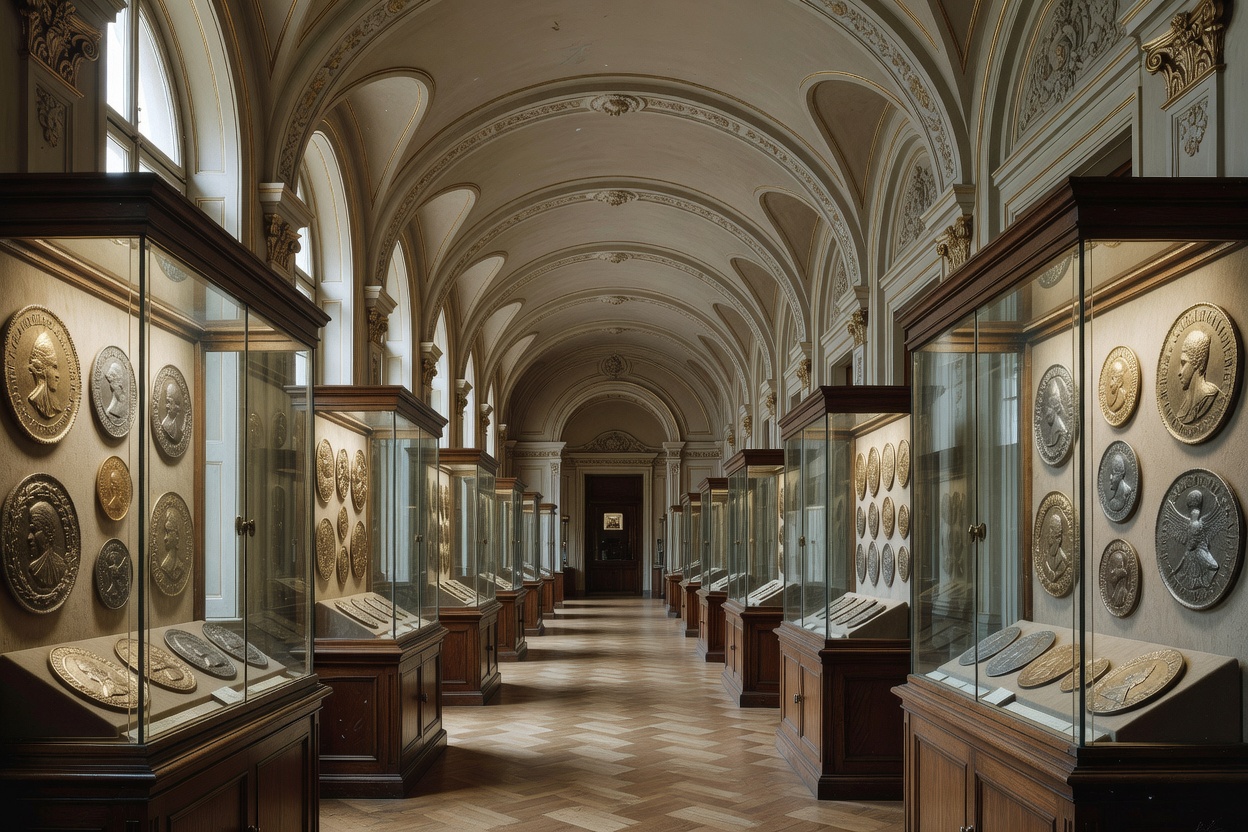
1. Historical Coin Cabinets of Europe
Major European coin cabinets originated as royal and princely collections during the Renaissance. The Münzkabinett at the Bode-Museum in Berlin, the Département des Monnaies, médailles et antiques at the Bibliothèque nationale de France in Paris, the Münzkabinett of the Kunsthistorisches Museum in Vienna, and the British Museum Coins and Medals Department in London hold hundreds of thousands of individual specimens.
These repositories do not merely display objects. They serve as primary diagnostic centers where type specimens establish the corpus for published catalogs.
2. Permanent Displays vs. Study Rooms
Typically, less than 2 percent of an institutional holding sits on public display in gallery showcases. The remaining 98 percent resides in secure archival drawers inside dedicated study cabinets.
Public Gallery Vitrines
Curated for chronological and historical narratives. Great for overviewing aesthetic evolution, but lighting angles and glass distance prevent microscopic die analysis.
Print & Coin Study Rooms
Designated desks where vetted researchers and serious collectors inspect specific trays under supervision using stereomicroscopes and precision balances.
3. How to Request Research Appointments
National institutions permit public research access, but you must respect protocol:
- Advance Notice: Submit requests 4 to 8 weeks before your intended visit date.
- Specific Inventory References: State the exact catalog numbers, mint, reign, or accession references you need to inspect. Open-ended browsing requests are routinely rejected.
- Identification: Provide institutional affiliation, photographic identification, and a concise summary of your research objective.
- Equipment Regulations: Handheld loupes (10x to 20x) are usually permitted. Calipers, scales, and personal tripods require prior written approval.
4. Digital Open Access Databases
Most premier European museums maintain digitized catalogs with high-resolution direct-lighting and oblique-lighting photographs. Portals such as Berlin's Interactive Catalogue of the Münzkabinett (IKMK) provide direct access to die links, weights, diameters, and findspot documentation.
Cross-referencing your private specimens against these standardized digital museum plates allows verification of die varieties without physical travel.
Comparing Public Vitrines with Digital Portals
In-Person Cabinet Examination
- Reveals actual metal reflectivity and accurate thickness.
- Permits edge inscription and reeding verification.
- Direct contact with institutional curators and subject specialists.
Online Digital Databases
- Immediate side-by-side comparison with private specimens.
- No appointment lead time or international travel expense.
- High-contrast macro photography shows minute tool marks.
Good For
Collectors building specialized typologies who need to inspect pristine mint specimens, unadulterated patinas, and certified archaeological provenance.
What to Know
Museum curators do not perform private commercial appraisals. Do not bring coins into a museum study room expecting a valuation certificate.